July 14, 2026
Understanding Dimensional Tolerance in Bulk Terracotta Facade Tiles Production
Introduction
Dimensional tolerance is one of those technical specifications that rarely makes it into marketing brochures but determines whether a facade project succeeds or fails. For architects, specifiers, and procurement professionals sourcing terracotta facade tiles in bulk, understanding dimensional tolerances is not optional—it is essential.
Terracotta is a fired ceramic material. It shrinks during drying, moves during firing, and responds to temperature and moisture throughout its lifecycle. Unlike industrially produced composites that can be held to near-zero variation, terracotta is a natural material with inherent variability. The question is not whether there will be variation, but how much variation is acceptable—and how to ensure that the tiles you receive fall within that range.
This guide provides a comprehensive overview of dimensional tolerances in bulk terracotta facade tile production, covering the key parameters, applicable standards, typical tolerance ranges, and practical considerations for procurement and quality control.
Why Dimensional Tolerance Matters
In a small-scale project, a tile that is 1mm oversized might go unnoticed. In a mega project covering 50,000 square meters, that same 1mm variation multiplies across thousands of tiles, creating cumulative alignment issues that can derail the entire installation.
Installation challenges are the most immediate consequence of poor tolerance control. Tiles that vary in length, width, or thickness require shimming, grinding, or selective sorting on-site, dramatically increasing labor costs and extending installation timelines. In some cases, significant variation may require re-fabrication of substructure components.
Aesthetic consistency suffers when tiles do not align perfectly. Uneven joint widths, wavy surfaces, and misaligned edges compromise the visual impact of even the most thoughtfully designed facade.
Structural performance can also be affected. The fixing system relies on consistent tile dimensions to transfer loads properly. Variation in thickness affects the clamping force of mechanical fixings. Variation in length affects the engagement of interlocking profiles.
Waste and cost increase when out-of-tolerance tiles must be rejected or reworked. For large projects, even a small rejection rate translates to significant material and labor costs, not to mention project delays.
Key Dimensional Parameters
Length
Length tolerance is typically specified in two ways: as an absolute value (e.g., ±1mm) or as a percentage of the nominal length (e.g., ±1%). The tighter of the two usually applies.
The ISO 10545-2 standard, which is widely referenced for ceramic tiles, specifies that length tolerance in the extrusion direction is typically ±1 mm for high-quality products, with an additional allowance of ±0.3% of the total length. For a 1200mm tile, this would mean a tolerance of approximately ±1mm plus ±3.6mm—so the total tolerance could be as wide as ±3.6mm when the percentage rule is applied.
In practice, premium manufacturers maintain tighter controls. Under EN14411 standards, many manufacturers specify length tolerance as ±1% / max. ±1mm for products following this standard. This means the deviation is limited to a maximum of 1mm, providing much tighter control than the percentage-based rule alone.
Chinese manufacturers often reference GB/T 4100-2006, which specifies length tolerance as ±1.5% / max. ±2mm. This is slightly more generous but still provides reasonable control for most applications.
For bulk orders, it is important to clarify which standard applies and whether the supplier is committing to the tighter "max. ±1mm" specification or the percentage-based rule.
Width
Width tolerance follows similar patterns. Under EN14411, many manufacturers specify ±1% / max. ±1.5mm for width. The Chinese GB/T 4100-2006 standard specifies ±1.5% / max. ±2mm.
The width of the tile is critical for joint alignment. Even a 1.5mm variation across hundreds of tiles can create visibly uneven joints that compromise the aesthetic quality of the facade.
Thickness
Thickness tolerance is typically expressed as a percentage of the nominal thickness. ISO 10545-2 specifies ±10% for thickness. For an 18mm tile, this would allow a variation of ±1.8mm—a range that most architects would consider unacceptable for a high-quality facade.
In practice, premium manufacturers specify tighter controls. Under EN14411, many specify ±10% / max. ±1.0mm for thickness. This provides a more reasonable maximum deviation of 1mm.
Chinese GB/T 30100-2013 specifies thickness deviation of ±0.5mm for a 15mm standard thickness. This is significantly tighter than the percentage-based rule and reflects the higher expectations for facade applications compared to general ceramic tiles.
Thickness uniformity is critical for the fixing system and for achieving a flat facade surface. Variation in thickness can cause the tiles to sit at different depths relative to the substructure, creating visible undulations.
Straightness of Sides
Straightness of sides—often called edge straightness—measures how closely the edges of the tile conform to a straight line.
Under EN14411, many manufacturers specify ±0.5% / max. (L:±2mm; W:±0.5mm) for side straightness. This means the long edges must be straight within ±2mm, while short edges must be straight within ±0.5mm.
Poor edge straightness creates uneven joint widths and makes alignment difficult during installation. It is particularly problematic for tiles with interlocking profiles or tight joint designs.
Rectangularity (Squareness)
Rectangularity—also called squareness or right-angle deviation—measures how closely the tile corners conform to 90 degrees.
Under EN14411, rectangularity is typically specified as ±0.5% / max. ±1mm. For a 600mm tile, this would allow a deviation of up to 1mm from a true right angle.
Poor squareness creates alignment issues, especially at the corners of the facade where multiple tiles meet. It can also affect the performance of interlocking profile systems.
Surface Flatness
Surface flatness encompasses two types of deviation: center curvature (warpage across the face of the tile) and edge curvature (warpage along the edges).
Under EN14411, center curvature and edge curvature are typically specified at ±1%. Warpage (overall distortion) is specified at ±1% under EN14411 and ±1.5% as an alternative.
Chinese GB/T 30100-2013 specifies surface flatness as ≤0.5% of panel length.
Warpage is particularly problematic for large-format tiles. A tile that is not flat will not sit flush against the substructure, creating stress points and potential failure points in the fixing system.
Additional Parameters
Other dimensional parameters that may be specified include:
Diagonal difference—the difference between the two diagonal measurements of a rectangular tile. This is another way of measuring squareness.
Warpage—overall distortion of the tile surface. This combines center and edge curvature into a single measurement.
Chamfer dimensions—for tiles with beveled or chamfered edges, the dimensions of the chamfer must also be controlled.
Applicable Standards
Several standards govern dimensional tolerances for terracotta facade tiles:
ISO 10545-2
ISO 10545-2 is the international standard for determining the dimensions and surface quality of ceramic tiles. It specifies test methods for length, width, thickness, straightness of sides, rectangularity, surface flatness, and warpage. Most manufacturers reference this standard for their dimensional tolerance specifications.
EN 14411
EN 14411 is the European standard for ceramic tiles, which specifies requirements and tolerances for various tile types. It is widely referenced by manufacturers supplying the European market. Products certified to EN 14411 undergo rigorous testing for dimensional accuracy and other performance parameters.
GB/T 4100-2006
GB/T 4100-2006 is the Chinese national standard for ceramic tiles. It specifies requirements for dry-pressed ceramic tiles, including dimensional tolerances. It is commonly referenced by Chinese manufacturers.
GB/T 30100-2013
GB/T 30100-2013 is the Chinese standard specifically for architectural facade ceramic panels (building curtain wall terracotta panels). It includes requirements for dimensional tolerances, including length (±1.5mm for panels under 300mm), thickness (±0.5mm for 15mm standard thickness), and flatness (≤0.5% of panel length).
ASTM Standards
ASTM C499 covers the standard test method for facial dimensions and thickness of flat, rectangular ceramic wall and floor tile. This test method is widely referenced for measuring dimensional tolerances.
ASTM C1167 covers clay roof tiles. While primarily for roofing applications, some of its principles apply to facade tiles.
Building Codes
The Florida Building Code, for example, requires clay tiles to comply with ASTM C1167 and mandates that a minimum of 1% of tiles received in each shipment be inspected for dimensions and weight.
Manufacturing Factors Affecting Dimensional Tolerance
Several factors in the manufacturing process influence the final dimensional accuracy of terracotta facade tiles.
Raw Material Consistency
The clay body must be consistent in composition, moisture content, and particle size distribution. Variation in any of these parameters affects drying shrinkage and firing behavior.
Extrusion and Forming
For extruded tiles, the extrusion pressure and die condition affect the cross-sectional dimensions. Worn dies produce inconsistent profiles. For pressed tiles, the pressing pressure and mold condition affect thickness and flatness.
Drying Control
Drying is one of the most critical stages for dimensional control. Uneven drying causes differential shrinkage, leading to warpage and cracking. Modern drying systems use precisely controlled temperature and humidity profiles to minimize these effects.
Firing Process
Firing is where the tile undergoes its final dimensional changes. The firing temperature, heating rate, and cooling rate all affect final dimensions. Firing at too high a temperature can cause excessive shrinkage. Too low a temperature leaves the tile under-fired and susceptible to moisture expansion.
Finishing Operations
Many terracotta facade tiles undergo finishing operations after firing, including grinding, sanding, and edge profiling. These operations can correct minor dimensional deviations but also introduce their own tolerances.
Quality Control and Inspection
In-process inspection at each stage of production is essential for maintaining dimensional control. This includes checking extruded profiles, dried blanks, fired tiles, and finished products. Modern quality control systems use laser scanning and other non-contact measurement methods to check dimensions quickly and accurately.
Typical Tolerance Specifications
The following table summarizes typical dimensional tolerance specifications from various sources:
Parameter | ISO 10545-2 / EN 14411 | GB/T 4100-2006 | GB/T 30100-2013 |
Length | ±1% / max. ±1mm | ±1.5% / max. ±2mm | ±1.5mm (<300mm) |
Width | ±1% / max. ±1.5mm | ±1.5% / max. ±2mm | — |
Thickness | ±10% / max. ±1.0mm | — | ±0.5mm (15mm standard) |
Straightness of Sides | ±0.5% / max. (L:±2mm; W:±0.5mm) | — | — |
Rectangularity | ±0.5% / max. ±1mm | — | — |
Surface Flatness | ±1% (center/edge curvature) | — | ≤0.5% of panel length |
Warpage | ±1% | — | — |
Surface Quality | ≥95% free from visible defects | — | — |
Practical Considerations for Procurement
Specify Tolerances Clearly
Do not assume that all suppliers use the same tolerance standards. Specify the applicable standard and the specific tolerance values you require in your purchase agreement. This should be a condition of the contract, not a topic for discussion after delivery.
Request Compliance Documentation
Require the supplier to provide mill test reports or third-party inspection reports documenting dimensional compliance. The reports should specify the measurement method, sample size, and results for each parameter.
Conduct Incoming Inspection
Even with a reliable supplier, it is essential to conduct incoming inspection on a statistically significant sample of each shipment. The sample size should be large enough to detect variations in dimensional quality.
Understand the Trade-offs
Tighter tolerances come at a cost. Achieving ±1mm length tolerance requires more precise manufacturing, more rigorous quality control, and potentially lower production yields. For most facade applications, the standard tolerances specified in EN 14411 or GB/T 30100-2013 are adequate. Specifying unnecessarily tight tolerances adds cost without commensurate benefit.
Consider the Installation System
The installation system can accommodate some dimensional variation. Some hanging systems are designed to accept tiles with tolerances of ±1mm in length and ±2mm in thickness. Others may be more forgiving. Understand the capabilities of your fixing system before specifying tolerances.
Account for On-Site Conditions
Remember that dimensional tolerances measured in the factory may not reflect performance on-site. Temperature and humidity variations affect the dimensions of terracotta tiles. Allow for thermal expansion and moisture movement in the design of the facade system.
Plan for Rejections
Even with the best quality control, some tiles will fall outside the specified tolerances. Plan for a rejection rate of 2–5% when ordering bulk quantities. This ensures that you have sufficient material to complete the installation without delays.
FAQ
Q: What is the standard dimensional tolerance for terracotta facade tiles?
A: Under EN 14411, typical tolerances are: length ±1% / max. ±1mm, width ±1% / max. ±1.5mm, thickness ±10% / max. ±1.0mm, and warpage ±1%. Under GB/T 30100-2013, length tolerance is ±1.5mm for panels under 300mm, thickness tolerance is ±0.5mm for 15mm standard thickness, and flatness is ≤0.5% of panel length.
Q: How do I verify tile dimensions during incoming inspection?
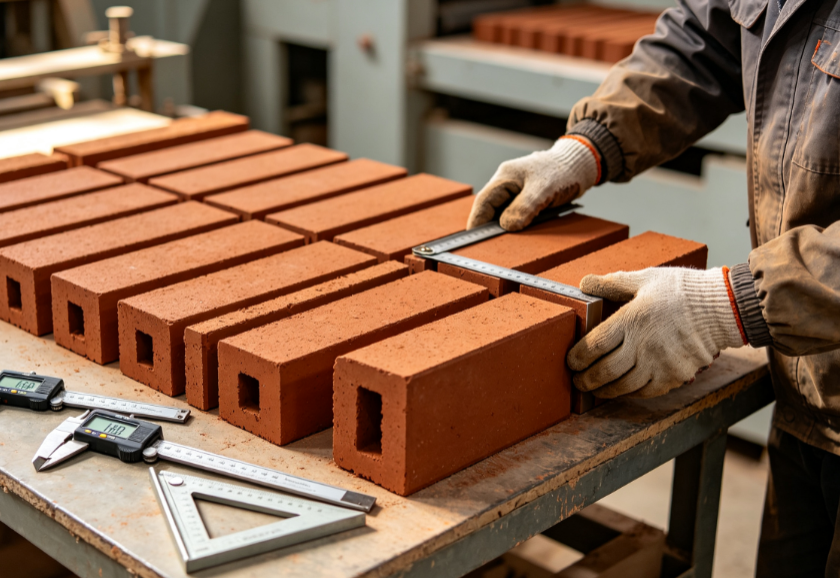
A: Use calibrated measuring instruments such as calipers, micrometers, and straight edges. For large volumes, consider laser scanning or optical measurement systems. Follow the measurement methods specified in ASTM C499 or ISO 10545-2.
Q: What causes dimensional variation in terracotta tiles?
A: Variation can arise from raw material inconsistencies, extrusion or pressing conditions, drying shrinkage, firing temperature variations, and finishing operations. Quality control at each production stage is essential for minimizing variation.
Q: Can out-of-tolerance tiles be used?
A: Some out-of-tolerance tiles may be usable in less visible areas or with additional on-site work. However, significant deviations from tolerance should be rejected. The decision should be based on the specific project requirements and the installation system's accommodation capacity.
Q: How much rejection should I plan for?
A: Plan for a rejection rate of 2–5% for bulk orders. This accounts for tiles that fall outside specified tolerances as well as those damaged during shipping or handling.
Q: What standards apply to terracotta facade tiles?
A: Key standards include ISO 10545-2 (dimensional measurement), EN 14411 (European requirements), GB/T 4100-2006 (Chinese general ceramic tile standard), GB/T 30100-2013 (Chinese facade panel standard), ASTM C499 (US test method), and ASTM C1167 (clay roof tiles).
Final Thoughts
Dimensional tolerance is not the most glamorous aspect of terracotta facade tile specification, but it is one of the most consequential. A project that ignores dimensional tolerances risks installation delays, aesthetic compromises, and structural issues. A project that specifies tolerances clearly, verifies compliance through incoming inspection, and works with a reputable supplier can avoid these pitfalls.
The key is to specify tolerances that are achievable and appropriate for the application, not the tightest possible. A 1mm tolerance is achievable with modern manufacturing. A 0.5mm tolerance may be possible but will add significant cost. The right tolerance is the one that balances performance requirements with cost and practicality.
When sourcing terracotta facade tiles in bulk, invest time in understanding the supplier's quality control processes, verifying dimensional compliance, and planning for the realities of on-site installation. The effort will pay dividends in a facade that looks as intended, performs as required, and lasts as long as designed.